

Digital Transformation Becomes Universal Priority
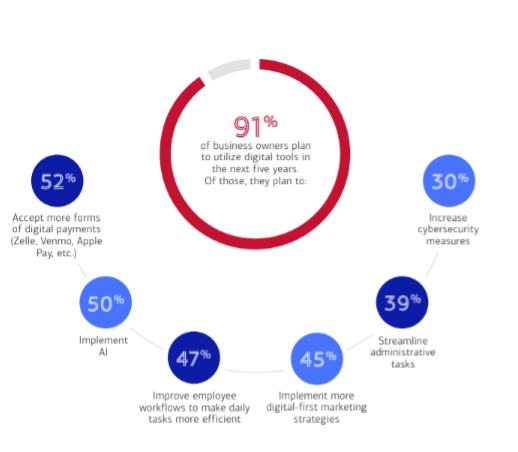
Nearly all business owners plan to utilize digital tools over the next five years, representing a sea change in how small businesses approach technology. This isn’t limited to tech-savvy startups or urban businesses; it spans industries, geographies, and demographic profiles. Among those planning digital tool adoption, priorities include:
- accepting more forms of digital payments like Zelle, Venmo, and Apple Pay (52%)
- implementing AI (50%)
- improving employee workflows to make daily tasks more efficient (47%)
- implementing more digital-first marketing strategies (45%)
- streamlining administrative tasks (39%), and
- increasing cybersecurity measures (30%).
The payment acceptance priority reflects customer expectations that businesses offer multiple payment options beyond cash and traditional cards. Younger consumers particularly expect seamless digital payment experiences, and businesses unable to accommodate these preferences risk losing transactions.
For banking executives, this digital transformation wave creates multiple opportunities:
- Businesses need financing for technology investments, including software subscriptions, hardware upgrades, implementation consulting, and employee training all require capital.
- Banks can differentiate by offering digital tools that integrate with business operations — real-time payment processing, automated reconciliation, cash flow forecasting, and working capital optimization.
- Advisory services that help businesses evaluate technology options, assess cybersecurity risks, and develop digital strategies become valuable relationship builders.
The banks that help customers navigate digital transformation successfully will become trusted partners rather than transactional service providers — strengthening loyalty and expanding wallet share as businesses grow more sophisticated.
Succession Planning Gap Threatens Business Continuity
Business owners show divided approaches to succession planning, with 60% having plans in place, but 40% lacking exit strategies. This gap proves particularly concerning given that 70% are not focused on exiting within the next five years.
The disconnect between lack of immediate exit plans and absence of succession strategies creates risk for business continuity, employee stability, customer relationships, and banking relationships alike. Many owners may assume succession planning only matters when exit is imminent, failing to recognize that health emergencies, family situations, or unexpected opportunities can accelerate timelines dramatically.
Among those with succession plans, the most popular exit strategy is transitioning the business to family members (32%). Family transitions dominate because many small businesses represent multi-generational enterprises where owners view businesses as family legacies rather than purely financial assets. These transitions can be emotionally satisfying but operationally complex, requiring careful planning around valuations, estate tax implications, management capability development, and sibling or cousin dynamics when multiple family members have ownership interests or expectations.
The 40% of small businesses that lack succession plans represent significant banking opportunity — and risk. Opportunity exists to provide succession planning advisory services, connecting owners with estate planners, M&A advisors, and family business consultants. Banks can facilitate family transitions through financing that enables purchasing generation to buy out selling generation while maintaining business liquidity for operations. Risk arises because unplanned ownership transitions — through death, disability, divorce, or disputes — can destabilize businesses, jeopardizing loan performance and relationship continuity.
Banking executives should proactively engage business customers on succession planning regardless of owner age or stated timeline, positioning these conversations as risk management and value preservation rather than end-of-relationship planning.
link