
When you think of artificial intelligence, you may think of robots or ChatGPT, but AI has become so widespread it’s not only taking over industries but college campuses.
What You Need To Know
- More than 100 schools across the country now offer either degrees in AI or computer science with a emphasis on artificial intelligence, including at the UUniversity of Southern California’s Viterbi School of Engineering
- It’s a joint program between computer science and electrical and computer engineering as well as industrial and systems engineering
- But that’s not the only option. — two years ago, USC launched its “artificial intelligence for business” degree, combining engineering with entrepreneurship.
- Goldman Sachs says AI could replace a quarter of work tasks in the U.S. and Europe, but it could also mean a boom in productivity
“There is so much going on in the world right now that we felt we had to develop a new degree focused solely on AI,” said Erik Johnson, vice dean for academic programs at the University of Southern California’s Viterbi School of Engineering, where students will be able to earn a bachelor’s of science in AI starting in the fall of 2026.
It’s a joint program between computer science and electrical and computer engineering as well as industrial and systems engineering.
“The BSAI [degree] will dig deeper in new applications of AI, computer vision, natural language processing and other things,” Johnson said.
But that’s not the only option. Two years ago, USC launched its “artificial intelligence for business” degree, combining engineering with entrepreneurship.
“You have really, really smart technical folks that speak the language of business and are oriented towards business problems,” said Charlie Hannigan, the program’s academic director.
“AI is not just, you know, one thing,” said Francesa Kubica, who’s now a junior in the AI-for-business”program. “It’s not just finance. It’s not just bio. It’s not just tech. You really can apply it to everything.”
Kubica was part of the inaugural class and recently completed a summer internship at Google.
“In our upcoming year, we get to actually learn how to build AI and then go do a capstone with actual companies and then apply it to their companies,” she said.
It’s a technology changing so fast that faculty and administrators say the challenge can be keeping up.
“This morning, I was having to change some lectures because they’re outdated,” Hannigan said.
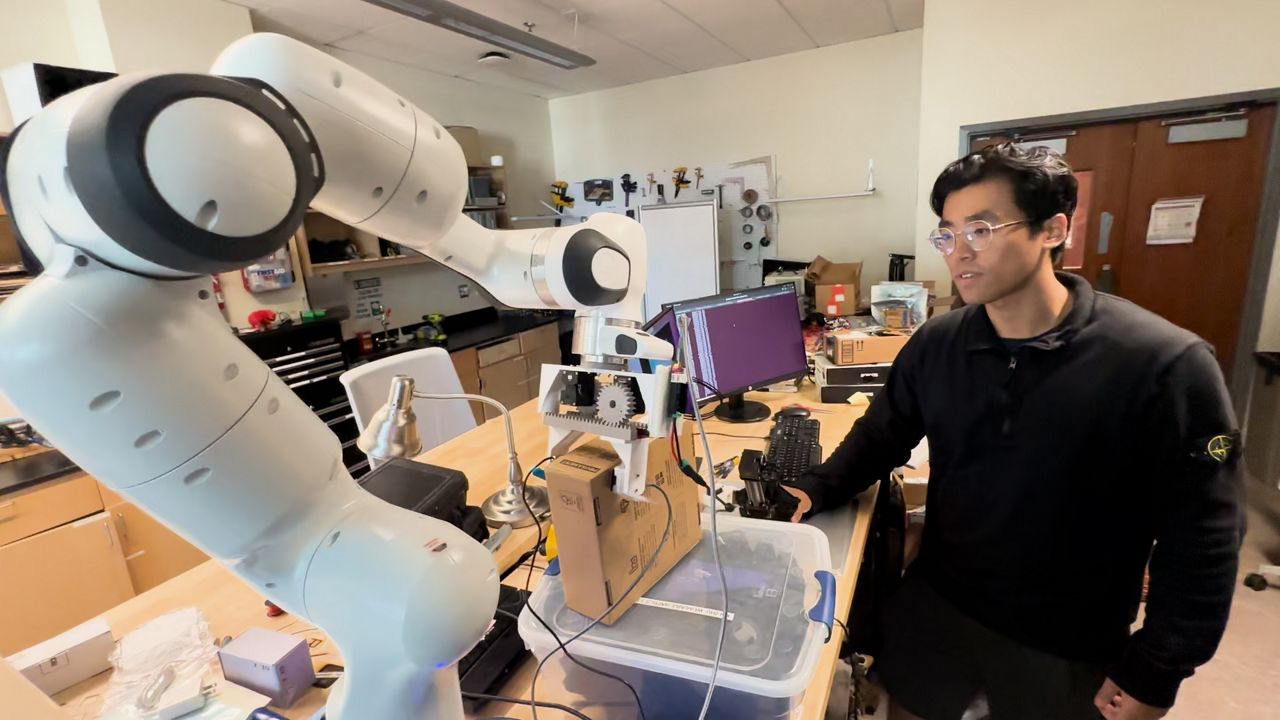
One of the ways AI is being used is inside a haptics lab at USC. Haptics is the science of touch, and what they’re doing is teaching robots how to identify various surfaces and textures.
The team is collecting information in a database using robots and AI algorithms that they can share with other scientists and researchers to train robots to distinguish between different kinds of materials and surfaces. It could eventually affect everything from graphic designers feeling the surface as they design to doctors getting feedback as they perform surgery remotely.
“I’m not worried about AI taking over the world, but at the same time, we also have to do things responsibly and make sure that we are developing models that are fair and are helpful,” Johnson said.
More than 100 schools across the country now offer either degrees in AI or computer science with a emphasis on artificial intelligence. Goldman Sachs says AI could replace a quarter of work tasks in the U.S. and Europe, but it could also mean a boom in productivity.
“It is definitely scary, but in terms of student, it’s exciting,” Kubica said.
And in many cases, the programs are preparing students for jobs that may not even exist yet. So, while the intelligence is artificial, it’s forging real pathways for students in higher education.
link