
Enterprise work has always depended on processes. Some are efficient. Many are not. Over time, even well-designed workflows become rigid. They rely heavily on manual checks, repeated approvals, and static decision paths that no longer reflect how the business actually operates.
Machine learning–driven automation changes this dynamic. It does not remove people from the equation. Instead, it restructures repetitive work into workflows that observe patterns, learn from outcomes, and continuously improve how tasks move across the organization.
This shift marks a practical evolution in AI in Business Process Automation. Automation is no longer about speeding up tasks alone. It is about creating systems that adapt alongside the enterprise.
Why Traditional Automation Hits a Ceiling
Rule-based automation brought early efficiency gains. If a condition was met, a predefined action followed. That logic still works for stable, predictable tasks.
But enterprises do not operate in predictable environments.
Processes involve exceptions, judgment calls, incomplete data, and changing priorities. Rule engines struggle here. Each exception adds complexity. Each update introduces maintenance overhead.
This limitation is what pushes organizations toward AI in Process Automation driven by machine learning rather than static logic.
Machine learning models do not wait for instructions to be rewritten. They infer patterns from data. They adjust behavior as conditions change. Over time, workflows become more accurate and less dependent on constant manual tuning.
Rule-Based Automation vs Learning-Based Automation
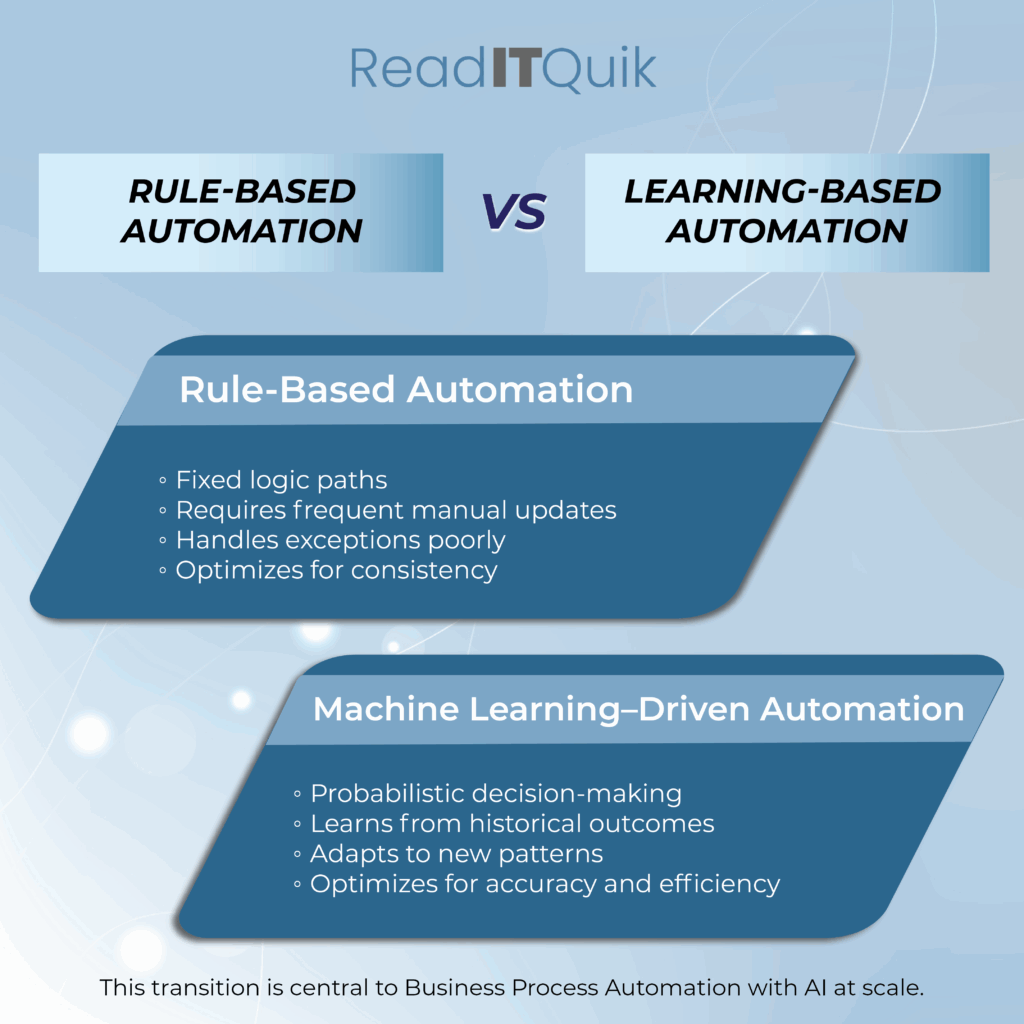
This transition is central to Business Process Automation with AI at scale.
This comparison highlights why many early automation initiatives plateaued. Rule-based automation performs well in stable environments but struggles when processes evolve or exceptions increase.
Machine learning–driven automation addresses this gap by learning from historical outcomes and adjusting decisions dynamically. Over time, this reduces dependency on manual rule updates and enables workflows to remain aligned with real-world operating conditions, which is essential for scalable AI in Business Process Automation.
What Makes a Workflow Self-Optimising
A self-optimising workflow improves without continuous human intervention. It does not mean autonomy without oversight. It means structured learning.
Three elements define such workflows.
- Observation: The system captures how tasks are performed, delayed, escalated, or resolved.
- Evaluation: Outcomes are measured. Not just completion, but quality, speed, and downstream impact.
- Adaptation: Future decisions change based on past results.
This feedback loop is the foundation of Machine Learning in Process Control.
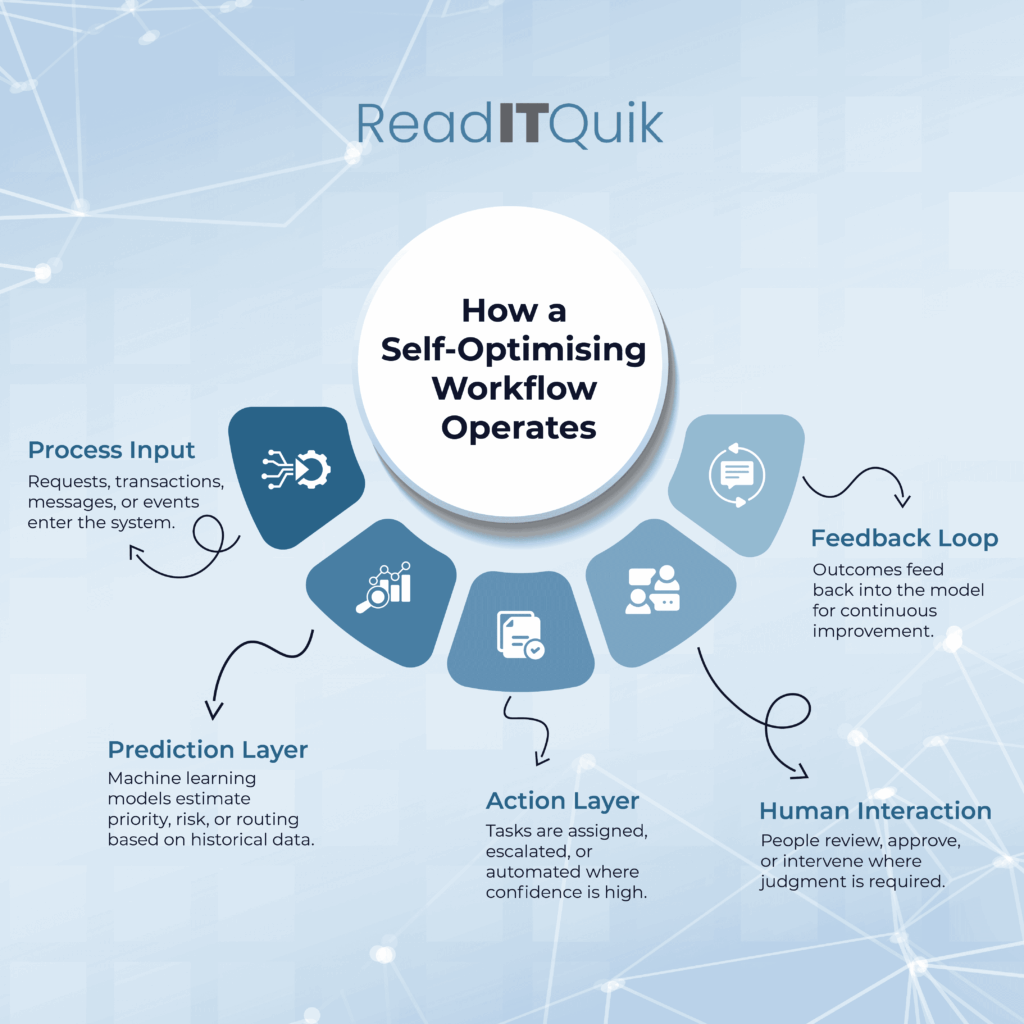
This cycle turns repetitive work into structured intelligence.
This flowchart illustrates how learning-driven workflows continuously improve without disrupting human oversight. Each stage builds on the previous one, ensuring that decisions are informed by data while still allowing room for human judgment.
The feedback loop is critical. It ensures that every completed task, whether successful or corrected, contributes to better predictions in the future. This structure enables enterprises to maintain control while benefiting from Machine Learning in Process Control.
From Manual Process Automation to Intelligent Automation
Many enterprises believe they have automated processes when they have only digitized them. Forms move faster, but decisions remain manual.
The difference between Manual Process Automation and intelligent automation becomes clear when scale increases.
Automation Maturity Levels
| Capability | Manual Automation | Machine Learning Automation |
| Decision logic | Static rules | Probabilistic models |
| Exception handling | Manual escalation | Pattern-based learning |
| Process improvement | Periodic reviews | Continuous optimization |
| Human effort | High | Focused on judgment |
To truly Automate Business Processes, learning must be embedded into the workflow itself.
The table demonstrates that automation maturity is not defined by how many tasks are automated, but by how decisions are made. Manual automation reduces effort but still relies heavily on human intervention.
Machine learning automation, on the other hand, embeds intelligence into the workflow itself. This allows organizations to move from reactive process management to proactive optimization, which is central to effective Business Process Automation with AI.
Where Enterprises Apply Machine Learning Automation Today
Machine learning automation is already embedded in daily enterprise operations, often without fanfare.
Finance and risk operations
Invoice classification, fraud detection, and expense validation rely heavily on AI in Business Decision Making. Systems learn which transactions need scrutiny and which can move forward automatically.
Customer operations
Support tickets are categorized and prioritized using AI in Business Communication tools that learn from past resolutions. Agents spend less time sorting and more time solving.
Supply chain and operations
Demand forecasting and inventory optimization use predictive models to reduce shortages and overstocking. This is a practical application of AI in Business Applications.
Compliance and audit
Monitoring systems identify anomalies across large datasets, supporting AI Risk Management without replacing auditors.
These implementations reflect how enterprises integrate intelligence without sidelining expertise.
AI Is Not Replacing People. It Is Redefining Where They Add Value.
One fear surfaces repeatedly in discussions around automation. Will machines replace human roles?
In reality, machine learning handles repetition and scale. Humans handle interpretation, ethics, and strategic decisions.
Teams working with AI Business Process Automation report consistent patterns:
- Reduced administrative workload
- Faster access to insights
- Better-informed decisions
- Higher engagement in complex problem-solving
The technology refines work. It does not diminish human potential.
Data as the Foundation of Learning Workflows
Machine learning automation depends on data quality and governance.
Poor data leads to unreliable predictions. Inconsistent inputs reduce trust. This is why Data Security in AI and governance frameworks are critical.
Enterprises must ensure:
- Clean, well-labeled datasets
- Secure access controls
- Transparent audit trails
- Continuous model monitoring
Without these, even advanced automation fails to scale responsibly.
The Enterprise AI Automation Stack
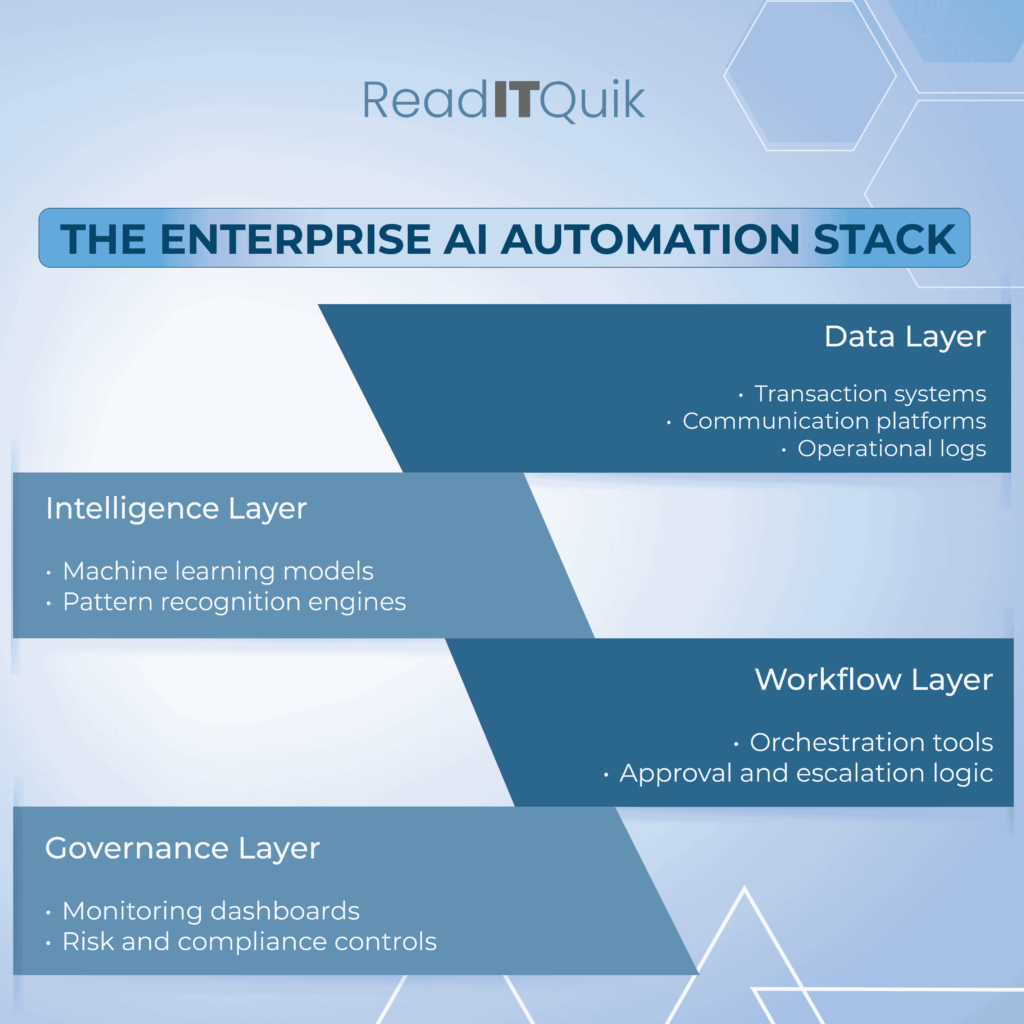
This layered view shows how machine learning automation fits into existing enterprise architecture. Each layer serves a distinct purpose, from data collection to governance. Ignoring any one layer weakens the entire system.
For example, strong models without governance create risk, while clean data without orchestration limits impact. Successful implementations balance all layers to ensure automation remains secure, scalable, and aligned with business objectives, especially in environments focused on Data Security in AI and AI Risk Management.
Probabilistic Thinking Changes Process Design
Traditional systems expect certainty. Machine learning works with likelihoods.
A workflow no longer asks whether a task should be escalated. It asks how likely escalation is needed.
This probabilistic mindset aligns with approaches such as Machine Learning a Probabilistic Perspective Solutions, where uncertainty is modeled rather than ignored.
For business leaders, this changes interpretation. Confidence scores matter. Trends matter. Context matters.
Governance, Trust, and Explainability
Automation earns trust only when people understand how decisions are made. In enterprise environments, opaque systems quickly face resistance, especially when automated outcomes affect customers, compliance, or financial performance.
This is why organizations deploying AI in Business environments place strong emphasis on governance and explainability from the outset.
Enterprises typically prioritize the following practices:
- Human override mechanisms that preserve accountability
Automated systems must allow people to intervene when outcomes appear incorrect or contextually inappropriate. Human override capabilities ensure that responsibility remains with decision-makers rather than being delegated entirely to algorithms. - Clear decision rationales that explain why an action was taken
Machine learning models should provide interpretable outputs, such as confidence scores or reasoning summaries, that help users understand how a conclusion was reached. This transparency builds confidence and improves adoption across teams. - Regular performance reviews to monitor model behavior over time
Automated systems must be evaluated continuously to ensure they remain accurate as data patterns evolve. Periodic reviews help identify drift, bias, or unintended consequences before they impact operations. - Transparent documentation that supports audit and compliance needs
Clear records of model logic, data sources, and changes over time are essential for regulatory scrutiny and internal audits. Documentation ensures that automation aligns with enterprise governance standards as it scales.
Together, these practices ensure that accountability remains intact while automation becomes more intelligent and widespread.
Measuring Success Beyond Cost Reduction
Cost savings often justify the initial investment in automation, but they represent only a fraction of the long-term value. The real impact of intelligent automation emerges when enterprises evaluate how processes perform over time and how decisions improve in quality and consistency.
Organizations that move beyond surface-level metrics focus on the following indicators:
- Process cycle time reductions that reflect smoother workflow execution
- Lower error and rework rates that signal better decision accuracy
- Greater decision consistency across teams and regions
- Improved employee satisfaction driven by reduced repetitive work
When these indicators improve together, automation transitions from a simple efficiency tool into a strategic capability.
Staying Informed in a Rapidly Shifting Landscape
The pace of change in automation and AI is constant. New tools emerge. Regulations evolve. Use cases mature.
Following Latest in AI Technology News and Latest News in AI helps leaders separate durable trends from short-lived noise.
This is where platforms like ReadITQuik play a critical role.
ReadITQuik focuses on the business impact of technology. It covers acquisitions, emerging platforms, and applied insights from practitioners who work with these systems daily. The publication bridges the gap between technical innovation and enterprise decision-making.
Conclusion
Machine learning–driven process automation is not about removing people from workflows. It is about removing friction from how work flows through organizations.
When implemented thoughtfully, it creates systems that learn, adapt, and support better decisions. Humans remain central. Technology works quietly in the background.
That balance defines the future of AI in Process Automation.
If you’re looking for clear, business oriented insights on how technologies like AI shape enterprise outcomes, subscribe to ReadITQuik.
Stay informed. Stay practical. Make better business decisions with confidence and real world insights.
link