



The emergence of Artificial General Intelligence (AGI) represents one of the most transformative technological developments in history, with profound implications for how businesses operate, compete, and create value. That is according to a new report from Kinetic Consulting.
The report, ‘The Future of Business: Preparing for Artificial General Intelligence’, outlines how Artificial General Intelligence differs from today’s narrower form of AI, emphasizing its human-like adaptability across domains such as strategic planning, creative problem-solving, and autonomous learning.
While current Al excels at specific tasks, such as language translation, image recognition, or data analysis, Artificial General Intelligence will possess the flexibility to understand, learn, and apply knowledge across any intellectual domain-mirroring human versatility in problem-solving and abstract thinking.
Current Al systems require supervised learning and operate within defined parameters, but Artificial General Intelligence will demonstrate autonomous learning, cross-domain knowledge transfer, and the ability to adapt to novel, unstructured situations without explicit programming.
“Artificial General Intelligence differs fundamentally from today’s narrow Al systems in its scope, adaptability, and autonomous reasoning capabilities,” summarized Joe Tawfik, CEO of Kinetic Consulting.
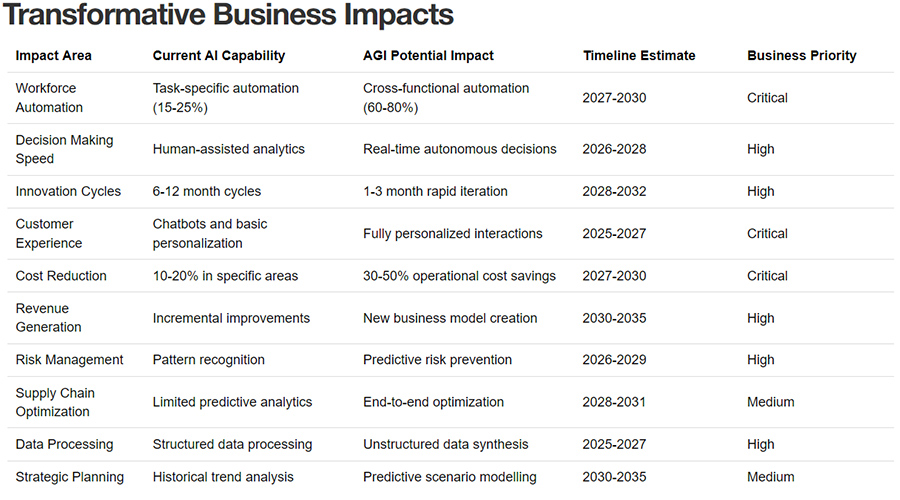
Transformative business impacts
Predicting its arrival as early as 2026, Artificial General Intelligence is set to unlock profound shifts to industries and domains.
“Artificial General Intelligence isn’t just another tool – it’s a fundamental inflection point comparable to the industrial revolution,” said Tawfik. “As we stand at the threshold of this technological revolution, organizations face an unprecedented challenge: preparing for a future where intelligent machines may fundamentally reshape every aspect of business operations.”

Source: Kinetic Consulting
Key transformative impacts outlined by the report include workforce automation, with Artificial General Intelligence housing the potential to automate 60% to 80% of cross-functional activities. Those gains could be achieved by 2030, up from around 15% to 20% automation that can be achieved by current AI systems.
Innovation is another major beneficiary of Artificial General Intelligence: innovation cycles could drop from the current 6-12 months to 1-3 months, combined with higher efficiency and success rates.
In the area of risk management, standard approaches could mature from (historical) pattern recognition to a much more intelligent and forward-looking system. In supply chain, the emergence of state-of-the-art analytics will power end-to-end optimization across value chains, with full visibility into products, logistical flows and other metrics, boosting efficiency, speed and resilience.
Meanwhile, basic chatbots used today will evolve into fully personalized robots that can power human-like interactions and offer predictive insights to both consumers and organizations.
Embracing the change
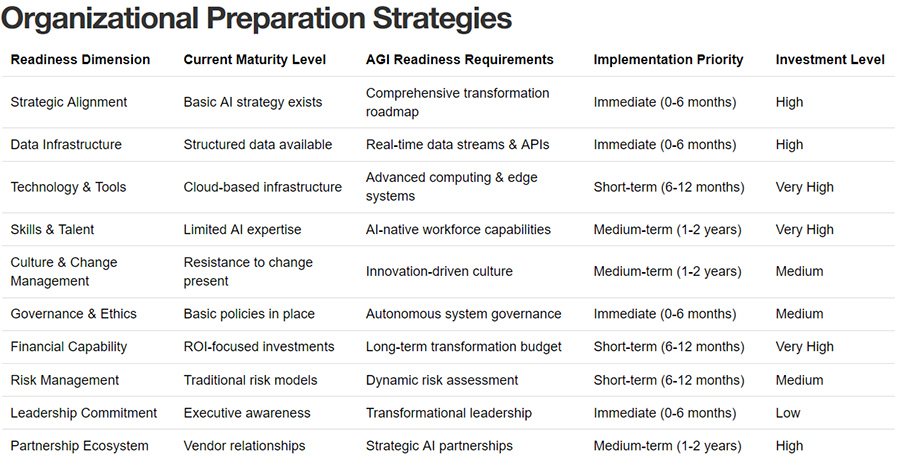
With the advent of Artificial General Intelligence representing such a fundamental inflection point for businesses, the report urges leaders to begin immediately with their strategic preparation.
“Organizations that invest in preparation today will shape the future, while those who delay risk permanent competitive disadvantage. The window is closing rapidly; 2025 is the year to act,” said Tawfik.
Key areas of preparation include defining the strategy for AI, working on the IT infrastructure, establishing governance frameworks for ethical and responsible use of AI, and preparing the workforce with the tech-savvy skills needed to thrive with AI.

Source: Kinetic Consulting
“Success will require not just technological investment, but also fundamental organizational transformation that aligns human and artificial intelligence capabilities,” said Tawfik. “Organizations should start with pilot implementations while building comprehensive readiness across data infrastructure, technology platforms, and human capabilities.”
The 20-section report from Kinetic Consulting, an award-winning boutique consultancy, provides actionable strategies across these dimensions, and also addresses risks, including security, privacy, bias, and regulatory compliance, advocating for ‘human-at-the-helm’ oversight models and explainable AI techniques. The study also emphasizes the need for multi-model AI approaches and strategic partnerships to build Artificial General Intelligence readiness.
“The window for acting is closing rapidly,” concluded Tawfik. “Organizations that establish readiness, begin pilot implementations, and develop transformation roadmaps in 2025 will be well-positioned to capitalize on the extraordinary opportunities that Artificial General Intelligence will create.”
link